







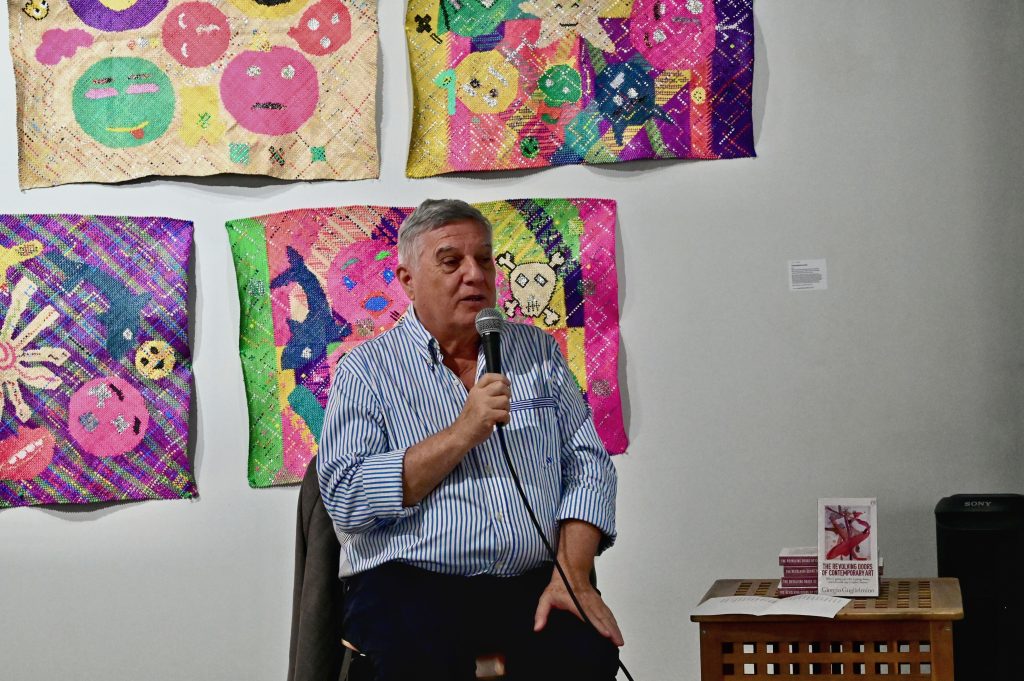
Art collector, author, and diplomat Giorgio Guglielmino recently
launched his new book, The Revolving Doors of Contemporary Art, which analyzes the
contemporary art system by categorizing artists into four distinct trajectories. The book,
published by Milflores Publishing, is now available online and in all branches of Fully
Booked nationwide.
The Revolving Doors of Contemporary Art was carefully written for both the discerning
art collector and the general public, using straightforward language to explain complex
art topics. The book presents a structured examination of how galleries, collectors,
visibility, and time interact within the global art economy. It is positioned as a practical
guide for collectors and cultural professionals seeking clarity on how reputations and
prices are formed and re-formed in contemporary art.
Four Categories Shaping the Art Market
At the core of the book is a four-part classification system. The first category identifies
artists Guglielmino describes as “those who are going up,” or artists currently favored by
the market. This includes established figures such as Tracey Emin as well as younger
artists like Sophie Barber, whose market momentum is reinforced by gallery
representation and social media visibility. The book notes the growing influence of
Millennial and Gen Z collectors in driving demand for highly visible artists.
The second category focuses on artists “who are going down,” defined as artists whose
market performance has softened in recent years. This includes historically significant
figures such as Dan Flavin and Donald Judd, whose auction results have declined, as
well as artists like Mimmo Paladino and James Brown, whose reduced visibility reflects
changing collector preferences and personal circumstances. The book situates these
trends within a globalized market where presence and engagement increasingly affect
outcomes.
Consistency and Long-Term Influence
The third category highlights artists who have maintained consistent, high-quality
practices without experiencing major commercial peaks. Artists such as Reinhard
Mucha and Fred Sandback are cited as examples of careers sustained by critical
respect and committed collectors rather than market volatility.
The fourth category is reserved for artists whose influence is widely considered
enduring. Guglielmino explains that artists such as Andy Warhol and Joseph Beuys
continue to remain as some of the most influential artists of the past eighty years,
alongside notable figures like Cy Twombly and Gerhard Richter.
Global Scope and Generational Shifts
Reflecting the author’s international background, the book includes artists beyond the
Western canon, with examples from the Philippines, Japan, Korea, China, and
Malaysia, including Martha Atienza, On Kawara, Lee Ufan, Xiyao Wang, and Yee I-
Lann. The book also observes that representation of women artists increases
significantly among younger generations.
Relevance to the Contemporary Art Market
The Revolving Doors of Contemporary Art enters the market at a time when
contemporary art is increasingly shaped by rapid shifts in visibility, collector
demographics, and global reach. By organizing artists into clearly defined trajectories,
the book provides a practical framework for understanding how value is created,
sustained, or diminished over time. It is positioned as a reference for collectors,
institutions, and cultural professionals seeking clarity in a market where artistic
significance and commercial performance do not always move in parallel.